The Formation Number Is Not a Player’s Job Description
A soccer formation number is a starting map, not a fixed job chart. See how one player’s role shifts as a team builds, defends, and attacks.
Why does a player listed in a 4-3-3 sometimes appear beside the center backs, then wide near the touchline, then sprinting into the penalty area? A soccer formation number describes the team’s broad starting arrangement; it does not lock each player into one spot or task. To follow the game, watch what the player is asked to do as possession and pressure change.
Consider a clearly invented match between Harbor City and Pine Athletic. Harbor City starts in a 4-3-3: four defenders, three midfielders, and three forwards. Its right-sided midfielder, Lena, is shown on the team sheet in the central line. That label is useful, but incomplete. Her actual role changes across the phases of play.
The team sheet gives Harbor City a starting map
Before kickoff, the 4-3-3 tells you how Harbor City expects to arrange itself when the players take their initial positions. Four defenders form the back line, three midfielders occupy the middle, and three forwards give the team options higher up the field. The numbers are read from the back toward the front; the goalkeeper is not included.
That arrangement offers clues, not a promise that every player will stay in a lane. A formation graphic also cannot show a player’s instructions, preferred foot, or the movement of teammates around them. Lena is a central midfielder, but that does not mean she must stand in the same patch of grass throughout the match.
For this invented situation, Harbor City’s coach has asked Lena to help the right back build attacks, move into space behind Pine’s midfield when Harbor City advances, and recover centrally when possession is lost. These are plausible tasks for a midfielder, but the exact assignment belongs to this imagined team. The useful point is to track her position relative to the ball, teammates, and opponents.
Harbor City changes shape while building from the back
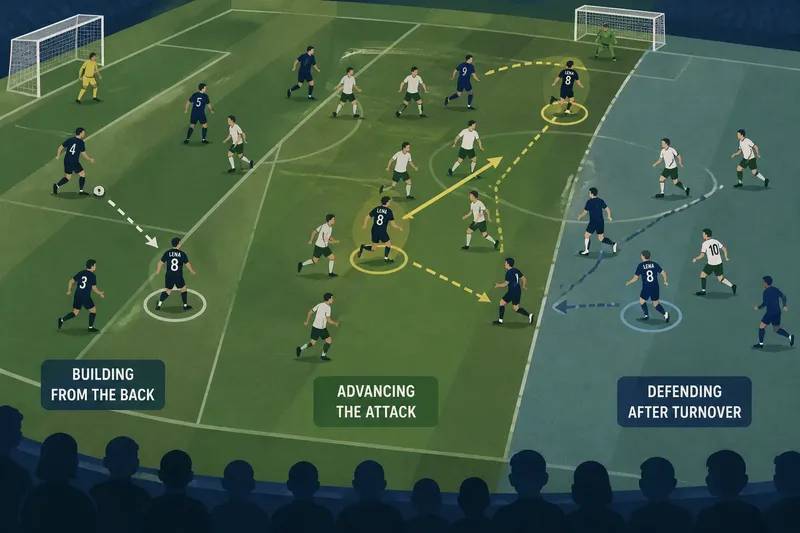
Harbor City’s goalkeeper rolls the ball to a center back. Pine’s front players press, trying to hurry the first pass. Lena drops toward the right side of Harbor City’s defense, leaving the midfield line to offer a short outlet. On the screen, she may look like another defender. Her job, however, is to provide a passing option and help the team carry or pass the ball beyond the pressure.
The right back has moved higher, so Lena’s drop also helps cover the space that player has left. This is a change in the team’s arrangement, not necessarily a permanent change of position. If Harbor City gets through Pine’s press, Lena can move forward again. If Pine wins the ball, her deeper position may help her respond quickly.
Watch for the trigger: the ball is with Harbor City’s defenders, and Pine is closing them down. Lena’s movement is easiest to understand as a response to that phase. Instead of asking, “Which line is she in?” ask, “What passing route or space is she helping the team create right now?”
Her role shifts when Harbor City gains ground
The center back finds the right back, who plays a firm pass inside to Lena. Pine’s nearest midfielder steps toward her. Lena turns away from that pressure and moves into the open space behind Pine’s midfield line. Harbor City’s right winger stays wide, drawing Pine’s left back toward the touchline; the forward in the middle occupies the center backs.
Now Lena is playing higher than the team-sheet graphic suggests. She can receive between the lines—the space between Pine’s midfield and defensive units—and choose whether to turn, pass wide, or feed the forward. Her role is not simply “get forward.” It is to make herself available where a pass can help Harbor City advance while the other attackers hold or stretch their positions.
The ball reaches Lena, but Pine’s midfielder blocks the direct pass to the forward. Lena sends the ball wide to the winger instead. The winger returns it toward the penalty area, where Lena arrives from behind the play. In this invented sequence, her late run gives Harbor City another attacking option without requiring her to remain near the box all the time.
That distinction matters when reading a formation. A midfielder can contribute to an attack by arriving at the right moment rather than camping in a forward’s starting position. Look at the timing of the run and the space it opens for others; a single snapshot of her location tells only part of the story.
A turnover sends Lena back into a different task
Pine’s defender clears the cross, and a Pine midfielder collects the loose ball. Harbor City no longer has possession. Lena turns toward her own goal and moves inside, between the ball and the center of the field. The right winger presses Pine’s ball carrier, while Harbor City’s forward tries to prevent a simple pass back through the middle.
Lena’s immediate task is now defensive: close a passing lane, help protect the central space, and be ready to challenge if the ball comes within reach. She is not expected to chase every opponent wherever they go. In this imagined plan, the team’s first response is to recover its shape and make Pine’s route forward less convenient.
Pine passes toward the left side. Harbor City’s left back steps out to meet the receiver, and the nearest midfielder shifts across to support. Lena stays central long enough to discourage a pass into Pine’s forward. Once Harbor City’s defense is set, she can take up a position in the midfield line again.
Here the team’s 4-3-3 is better understood as a reference shape than a frozen diagram. During an attack, Harbor City’s players spread and move to create options; while defending, they compress and shift to cover space. The underlying formation remains a useful shorthand, but the phase explains why Lena appears to leave her listed position.
What should you watch when a player leaves her listed position?
Does the player move with the ball or away from it?
Movement toward the ball may offer a short pass or provide cover, while movement away can open a lane or stretch the defense. Neither direction has one universal meaning; notice which teammate benefits from the space created.
Who fills the space she leaves?
If another player moves into Lena’s previous area, the team may be exchanging responsibilities rather than abandoning that part of the field. Track the nearest teammate as well as the player whose movement first caught your eye.
What changes when possession turns over?
A player’s attacking position may become a defensive starting point for a recovery run. Watch the first movement after the turnover: it often reveals whether the player is pressing, covering a lane, or dropping toward the team’s goal.
Is the change temporary or part of the team’s settled shape?
One run does not necessarily mean a permanent role change. If the player returns to a familiar area once the phase settles, the movement was likely part of a specific action; repeated rotations may point to a broader tactical instruction.
The sequence matters more than the formation label
In the invented match, Lena begins as a central midfielder, drops to support the build-up, moves between Pine’s lines as Harbor City advances, runs into the box as the attack develops, and recovers centrally after the turnover. Those movements do not contradict the 4-3-3. They show how a player’s responsibilities can adapt to the team’s immediate problem.
For a useful viewing habit, follow one player through a complete possession and the transition that follows it. Note where the ball is, what space opens, and which teammate adjusts. You do not need to memorize a separate formation for every moment; the formation number is a starting clue, while the sequence reveals the job.
The next time a graphic calls someone a midfielder, treat that label as context rather than a boundary. In soccer, the formation number helps you orient yourself, but the player’s role is clearest in motion—especially when the ball changes hands.