From Chalk Marks to Scoreboards: Keeping Track of Play
Learn to read sports scorekeeping, from chalk marks to electronic boards, and spot what each display shows, hides, or may have failed to update.
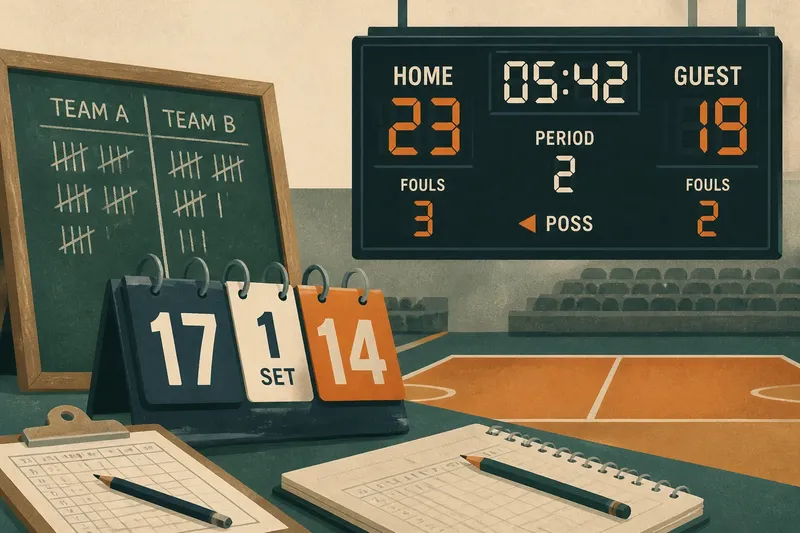
Why does the scoreboard say one thing while the players seem to be playing another? Reading sports scorekeeping—from chalk marks to electronic boards—means separating the game’s actual state from the way someone has chosen to display it. A mark on a wall, a flip card, and a digital panel can all report a score, but they differ in what they show, how quickly they change, and where an error can creep in.
That distinction matters most when play is interrupted, a point is disputed, or the display seems out of step. The score is not the whole state of a game: the period, clock, possession, count, and penalties may also shape what a number means. Treat the display as a helpful record, not as the game itself.
Read the display as a record with limits
A scorekeeper turns events into visible information. In a simple running tally, each mark stands for a point or score. A more elaborate board may add team names, period, clock, fouls, outs, or other sport-specific details. Each extra field can answer another question, but it also creates another opportunity for a value to be missing or misunderstood.
Start by asking what the display is designed to tell you. In basketball, the score and game clock are prominent, but a foul count can affect how a team defends. In baseball, the runs alone do not tell you whether the inning is still underway; the inning and outs matter too. A small display may be accurate about one part of play while leaving the rest unstated.
Older manual systems make the record especially visible. Chalk or pencil marks accumulate; a volunteer may turn a card or move a marker after an event. Their strength is legibility at a glance when the notation is familiar. Their weakness is that the system relies on a person to make the mark, and the mark may not explain what happened if a correction is needed.
When the displayed score does not match the play
A mismatch often begins with a delay rather than a dramatic mistake. The scorer may wait for an official signal, finish recording one event before entering another, or be unable to see the action clearly. A spectator looking at the board during that gap can mistake an update in progress for a settled decision.
Try this order before deciding that the score is wrong:
- Pause on the event. Identify what just happened: a goal, basket, run, point, penalty, or ruling. Don’t add a score merely because the crowd reacted.
- Check for an official signal. In many sports, the referee or umpire’s decision determines whether a score counts. The board may wait for that confirmation.
- Look for the next display update. A manual operator may need time to change a card or marker; an electronic operator may be entering the event through a control system.
- Compare related fields. A changed period or game clock can help show whether the board has advanced, even if the score has not yet changed.
- Keep the uncertainty open. If officials are discussing a play, treat the displayed total as provisional until play resumes or the ruling is clear.
Imagine you are watching a volleyball set and a rally ends with an apparent point. The score panel remains unchanged while the referee speaks with the scorer. Rather than mentally adding the point, you wait for the signal and the board’s next update; if the rally is awarded differently, your running understanding stays aligned with the official decision.
When a mark or number is hard to interpret
Manual records can be ambiguous because a tally may be crossed out, overwritten, or placed in a column whose meaning is not obvious to a newcomer. Even tidy chalk marks require a shared convention: one line might mean a point, while a grouped set might track outs or rounds. Don’t assume every mark is a score.
Read the labels and the layout before interpreting the symbols. Check which side or team owns a column, whether a heading names a period or a total, and whether marks are grouped by inning, set, or round. If there are no labels, follow the changes over time and watch what event corresponds to each update. A single snapshot is often less informative than the display’s sequence.
For electronic boards, the same caution applies in a different form. A glowing number can look authoritative even when it belongs to the wrong field: a period number may be mistaken for a team score, or a timeout indicator for a score-related count. Read the field label, not just the largest digits. If the layout is unfamiliar, compare it with the scoreboard’s printed legends or the venue’s public display conventions.
When the clock changes but the score does not
A clock and a score are separate records, often handled through different controls. The clock may run continuously while a scorer enters points by hand. In other setups, a clock operator and scorekeeper coordinate, but a pause, substitution, review, or dead-ball situation can still make the fields update at different moments.
First decide whether the clock is meant to be running under the sport’s rules at that moment. Then look for the game state around it: a whistle, a period break, a review, or a restart. A stopped clock does not mean the scorekeeper has finished entering an event, and a moving clock does not prove that the score is settled. Keep the two questions separate: “What is the score?” and “How much play remains?”
This also helps with displays that show a countdown, shot clock, or elapsed time alongside the main clock. Those clocks serve different purposes. If one reaches its limit while another continues, the apparent contradiction may reflect distinct rules rather than a malfunction. Follow the labels and the officials’ signals before inferring what should happen next.
When an electronic board freezes or shows stale information
An electronic scoreboard depends on an input system, a connection to the display, and power. A visible panel can stop changing even while the game proceeds; the operator may be entering events on a separate console, or a display connection may be interrupted. From the stands, those causes can look alike, so avoid guessing at the technical fault.
Look for signs that distinguish a frozen display from a delayed update. Do the period and clock change? Are other fields updating while the score stays still? Does a backup board, venue announcement, or official signal provide a clearer account? If the entire display is blank or static, rely on the visible play and authorized announcements rather than treating its last number as current.
Electronic systems can also make correction easier to display, but a correction is not always immediate. An operator may need confirmation, and a revised number can appear after an official ruling. When a score changes backward, don’t assume the board has made a new error; a previously credited point may have been removed. Watch for the ruling and the scorekeeper’s update together.
How should you handle an apparent scoring error?
Should I trust the scoreboard or the official?
The board communicates the recorded state, while the officials’ decisions govern play. If they appear to conflict, pay attention to the official ruling and wait for the display to catch up rather than treating the board as the final authority.
Why can a score change after play has stopped?
A review or discussion may change whether an event counts or how it is credited. The display can be corrected once the ruling is settled, so a late adjustment does not by itself mean the current operator entered a fresh mistake.
What should I do if the display is unreadable?
Use the public address, a clearer secondary display, or the sequence of visible events and official signals. If the venue provides no reliable alternative, accept that a field may be unknown rather than filling the gap with a guess.
Can a manual scoreboard be more reliable than an electronic one?
Either can communicate the score clearly when its operator and conventions are understood. Manual systems are vulnerable to missed or unclear marks; electronic systems can show stale or misassigned fields, so the method alone does not settle whether a display is current.
Notice what each method leaves out
Chalk marks preserve a simple trail, but they may not capture context or make corrections obvious. Flip boards make a current total easy to see from a distance, yet usually offer little history. Electronic panels can show more parts of the game at once, but a crowded display can bury the field a spectator actually needs. More information is useful only when its labels are clear and its updates are timely.
What is not worth the effort? Trying to reconstruct every hidden control-room action from the seating area. A spectator usually cannot tell whether a delayed change comes from an operator, a connection, or a pending ruling. Track the visible fields that matter, notice official signals, and leave the unobservable cause unresolved.
For a clearer read of sports scorekeeping, follow the display as a sequence: what changed, which event prompted it, and whether the official decision has settled. That habit works with a chalk tally at a local field or a bright electronic board in a crowded arena. It also makes the quiet parts of the record visible: a period label, an unchanged clock, or a corrected total can tell you as much as the headline score.